Have you ever noticed that video streaming runs smoothly on one network but lags on another? 5G feels like moving from a bumpy side road to a smooth superhighway. With speeds that can be up to 100 times faster than 4G, downloads, gaming, and video calls happen almost instantly. In this post, we compare the two networks and show how 5G sets a new standard for mobile connectivity while 4G still handles the basics.
5G vs 4G Smartphone Speed: Core Performance Differences
5G is a game-changer for your smartphone. It can hit speeds of up to 10 Gbps, making it almost 100 times faster than the usual 20–100 Mbps you get on 4G LTE. This means you could download a full-length movie in just seconds instead of waiting for minutes.
Latency is even better with 5G. With a delay as low as 20 ms, activities like gaming and video calls feel nearly instantaneous. In comparison, 4G’s 50–100 ms delay can cause noticeable lags during fast-paced tasks.
Another big perk of 5G is its ability to handle crowding. It supports up to 1 million devices per square kilometer, a huge boost over 4G. This makes 5G more reliable in busy spots like stadiums or large events.
Key differences at a glance:
- Up to 100× faster speeds
- Ultra-low latency around 20 ms vs 50–100 ms
- Supports up to 1 million devices per km²
These improvements show how 5G overcomes the limits of older networks and sets a new standard for mobile connectivity.
5g vs 4g smartphone speed explained: Blazing Speed

5G is a big leap forward from 4G. It relies on a technique called Massive MIMO, which uses 64, 128, or even more antennas at a base station instead of the usual 4 found on 4G LTE towers. This extra hardware allows the network to send and receive much more data at the same time. Think of it like a busy sports event where every phone streams high-definition video without a hitch because the network handles many connections as smoothly as a well-organized team.
Another neat trick with 5G is intelligent beamforming. Instead of broadcasting a wide, unfocused signal, the network sends a tight beam of radio energy straight to your device. At a busy concert, for example, while a 4G connection might drop calls or slow down your internet, 5G keeps things running smoothly even if you're on the move. This targeted method improves both range and efficiency, ensuring a steady connection in crowded spots.
Additionally, 5G taps into new frequency bands like sub-6 GHz and mmWave to deliver much faster speeds. There are three deployment modes: low-band, mid-band, and mmWave. Each type serves a unique need by balancing area coverage with peak performance. This setup supports the advanced features found in modern 5G smartphones.
Real-World Benchmark Speeds: Download and Upload Metrics
Recent controlled tests give us a clear picture of how different networks perform. Earlier tests showed that 4G LTE offers about 20–50 Mbps for downloads, 10–20 Mbps for uploads, and 50–100 ms latency. New tests now compare mid-band and mmWave 5G. With perfect conditions, mmWave can hit 1–3 Gbps in downloads, but it needs a clear line-of-sight. In contrast, mid-band consistently delivers 200–300 Mbps downloads, 30–60 Mbps uploads, and around 20 ms latency in everyday use.
These tests show that mmWave's high speeds come with a short range. Mid-band, however, strikes a good balance between speed and reliability. In one controlled test, a mid-band device maintained 250 Mbps in a busy downtown area. This mix of performance makes mid-band ideal for smooth streaming and fast, everyday interactions.
| Network Type | Download Speed | Upload Speed | Latency |
|---|---|---|---|
| 4G LTE | 20–50 Mbps | 10–20 Mbps | 50–100 ms |
| 5G Mid-Band | 200–300 Mbps | 30–60 Mbps | ~20 ms |
5G vs 4G Latency Differences and Impact on Applications
5G networks can cut delay down to 20 ms or less, while 4G usually takes about 50 to 100 ms. That shorter delay makes a big difference for apps that need fast responses. Mobile games, for example, feel snappier because there is almost no lag after you tap a button. Video calls also work better on 5G. People notice a smoother talk with no awkward pauses.
We measure latency with tests like ping (the time it takes for data to travel) and jitter (how much that time varies). In day-to-day tests, 5G keeps ping times lower even with different signal strengths. This lower delay makes cloud apps or virtual reality feel more real. It also helps apps like augmented reality, where every millisecond matters.
Here are some ways lower latency helps:
- Mobile gaming: Faster reaction time improves gameplay.
- Video conferencing: Fewer delays means clearer conversations.
- AR/VR: Quicker scene changes make visuals more realistic.
- Cloud apps: Speedier responses boost work efficiency.
Overall, 5G delivers sharper, more real-time performance for apps that depend on fast data exchange.
Network Capacity and Reliability: 5G vs 4G in Crowded Areas
5G networks are built to handle heavy user loads. They can support up to 1 million devices per km², while 4G has a much lower capacity. This means that in busy environments like sports arenas or concerts, 5G keeps a steady connection when 4G may slow down.
Network slicing allocates specific chunks of bandwidth to different groups of users. This focused method cuts down on interference and helps every device perform well even during peak times.
Massive MIMO ramps up network capacity by using many antennas instead of the typical four found in 4G towers. This extra hardware boosts data speed. Intelligent beamforming then sends a focused signal directly to devices, ensuring clear connectivity even when many are online.
Imagine a busy urban area where everyone is streaming videos and sharing photos live. With 5G, the network stays smooth and reliable. In contrast, 4G often slows down under the same conditions, showing a clear edge for 5G in crowded settings.
Evolution from 4G LTE to 5G: Adoption and Deployment Trends
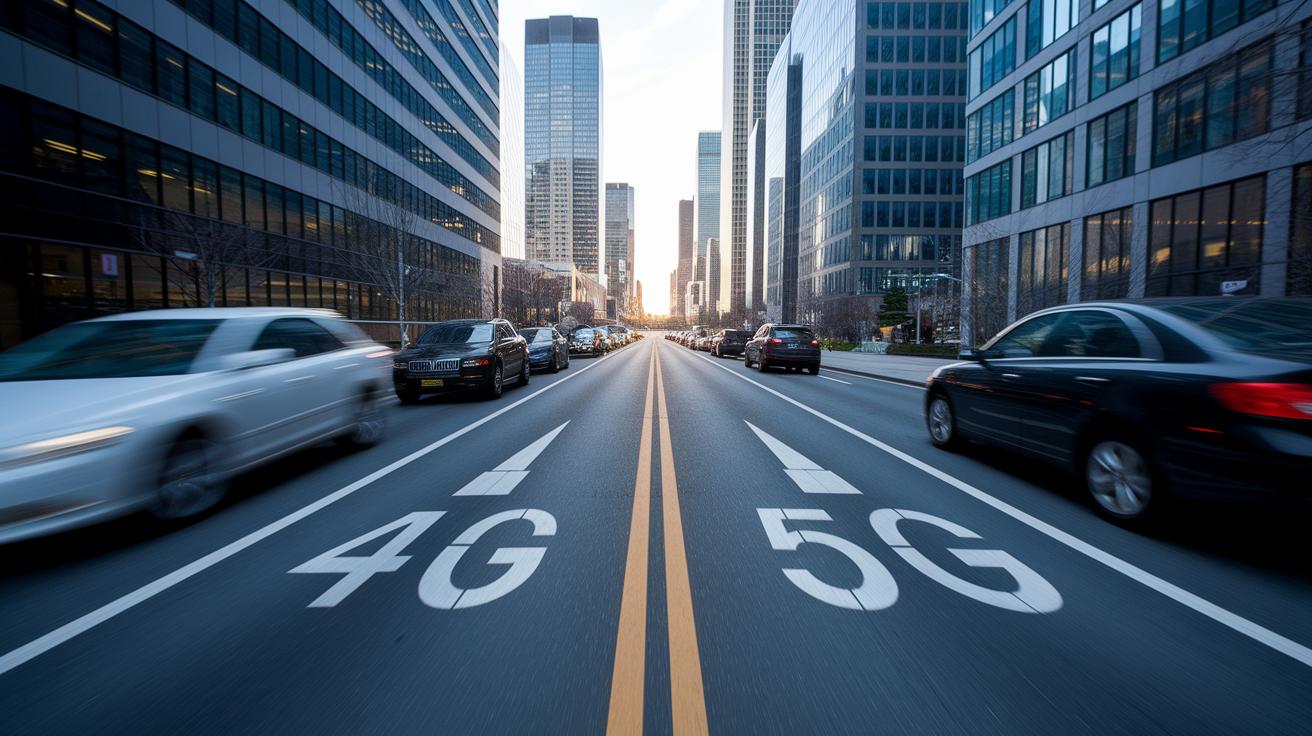
4G LTE ruled the mobile scene in the 2010s. It gave us steady speeds for streaming videos, browsing social media, and handling work tasks. Think of it like a quiet highway that suddenly got crowded when rush hour hit.
The change started around 2019 when the first 5G smartphones were released. These phones offered much faster speeds and very low delays. By 2023, 5G devices became cheaper and more common, making this new network the standard. Early 5G networks focused on low-band and mid-band frequencies to cover large areas while still boosting performance. In big cities, high-frequency (mmWave) networks were introduced to offer extremely fast downloads in busy areas.
This quick move from 4G LTE to 5G shows just how fast mobile networks can change. It’s like upgrading from a small town road to a wide, busy highway that lets even more cars travel quickly and smoothly.
Pros and Cons of 5G vs 4G Smartphone Speeds
5G speeds offer a clear boost in performance for busy networks, but they also bring some trade-offs that 4G does not have. Below is a fresh look at the benefits and drawbacks of 5G versus 4G.
Pros:
- Faster, more responsive connections in crowded areas.
- Better network handling even when many devices are connected.
Cons:
- Limited mmWave range (a type of 5G that works best at close range) leads to spotty coverage.
- 5G modems use more battery power.
- Performance can vary between city centers and rural zones.
- Data plan costs may be higher.
- Many older devices cannot use 5G.
Final Words
In the action, we broke down the differences between 5G and 4G smartphone networks. We looked at speed, latency and capacity, explaining how 5G brings humbler delay and stronger crowd performance, all while comparing real-world measurements.
The piece also covered key hardware features that drive these gains. When it comes to 5g vs 4g smartphone speed explained, the data shows clear benefits if you need fast, reliable performance.
Enjoy smarter connectivity ahead!
FAQ
Q: Verizon 5G vs 4G smartphone speed explained
A: Verizon’s 5G network delivers much faster speeds, lower latency, and higher capacity compared to its 4G network because it employs advanced antenna and frequency technologies.
Q: How are 5G and 4G smartphone speeds discussed on platforms like Reddit, Samsung, and T-Mobile?
A: Discussions on Reddit, Samsung forums, and T-Mobile comparisons note that 5G smartphones offer significantly higher download speeds, lower latency, and better performance in crowded areas than 4G devices.
Q: What are the technical differences between 4G and 5G networks and how does LTE relate to 4G?
A: The technical differences include 5G’s use of Massive MIMO, beamforming, and new frequency bands while LTE, a type of 4G, uses simpler antenna setups, resulting in lower speeds and higher latency.
Q: How does a 4G vs 5G comparison table highlight the performance gap?
A: A comparison table shows that 5G can deliver download speeds up to 10 Gbps with latency around 20 ms, whereas 4G typically offers 20–100 Mbps with higher latency, revealing a clear performance leap.
Q: What are the disadvantages of 5G compared to 4G?
A: The disadvantages of 5G include limited mmWave range, higher battery consumption, uneven signal coverage between urban and rural areas, and the potential for higher data plan costs.
Q: Is 5G actually faster than 4G?
A: Yes, 5G is faster, offering download speeds that can reach up to 10 Gbps in ideal conditions, with much lower latency, making it better suited for data-intensive apps and real-time activities.
Q: Is upgrading to or paying extra for a 5G phone worth it?
A: Upgrading to a 5G phone is worth it if you need faster speeds, lower latency, and improved performance in well-covered areas, but for basic usage, 4G still suffices as a cost-effective option.